
Resilio Compliance Suite
Resilio Compliance Suite
Resilio Compliance Suite is a B2B SaaS platform designed to help organizations manage operational resilience, business continuity, disaster recovery, third party risk, and compliance from one centralized system. The platform enables organizations to create and monitor Business Impact Analyses (BIAs), Business Continuity Plans (BCPs), and Disaster Recovery Plans (DRPs). These modules are connected to provide complete traceability between critical business processes, supporting systems, continuity procedures, recovery requirements, and responsible stakeholders. Resilio replaces disconnected spreadsheets, documents, and manual compliance processes with structured workflows, centralized records, role based access, maturity analytics, and real time status monitoring.
Organizations often manage business continuity and disaster recovery information through spreadsheets, shared folders, emails, and independent documents. Resilio was developed to replace that fragmented approach with structured workflows, centralized records, role based access, maturity analytics, and real time status monitoring. The platform is designed for enterprises, consulting providers, and organizations managing multiple business entities that need complete traceability between BIAs, BCPs, DRPs, third party risks, and responsible stakeholders.
Challenges faced by Resilio Compliance Suite

Critical business processes are not consistently assessed.
Business dependencies and supporting systems are difficult to track.
BIAs, BCPs, and DRPs are maintained separately.
Recovery responsibilities are unclear during an incident.
Plans become outdated because reviews and deadlines are managed manually.
Third party systems are not included in internal recovery planning.
Management lacks a clear view of organizational resilience.
Compliance teams struggle to demonstrate traceability during audits.
Key Features
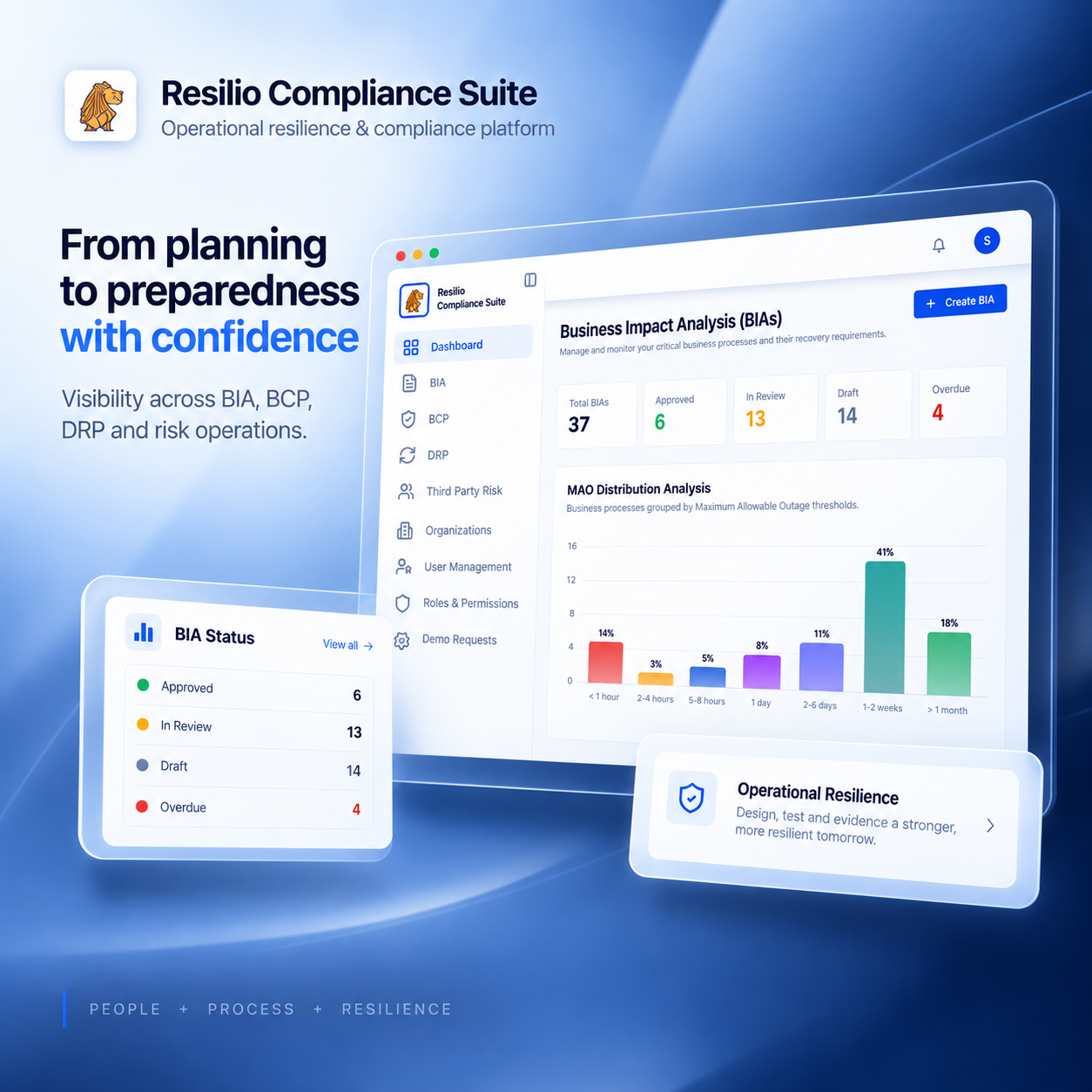
Operational Resilience Dashboard: The centralized dashboard displays total BIAs, BCPs, and DRPs, approved plans, plans currently under review, plans in progress, plans not yet started, overdue plans, and plans created or updated during the current month.
Operational Resilience Maturity Scoring: Resilio calculates an overall operational resilience maturity score across BIA coverage, BCP coverage, DRP coverage, plan testing, third party resilience, and compliance readiness, helping organizations understand whether their program is reactive, repeatable, proactive, or measured.
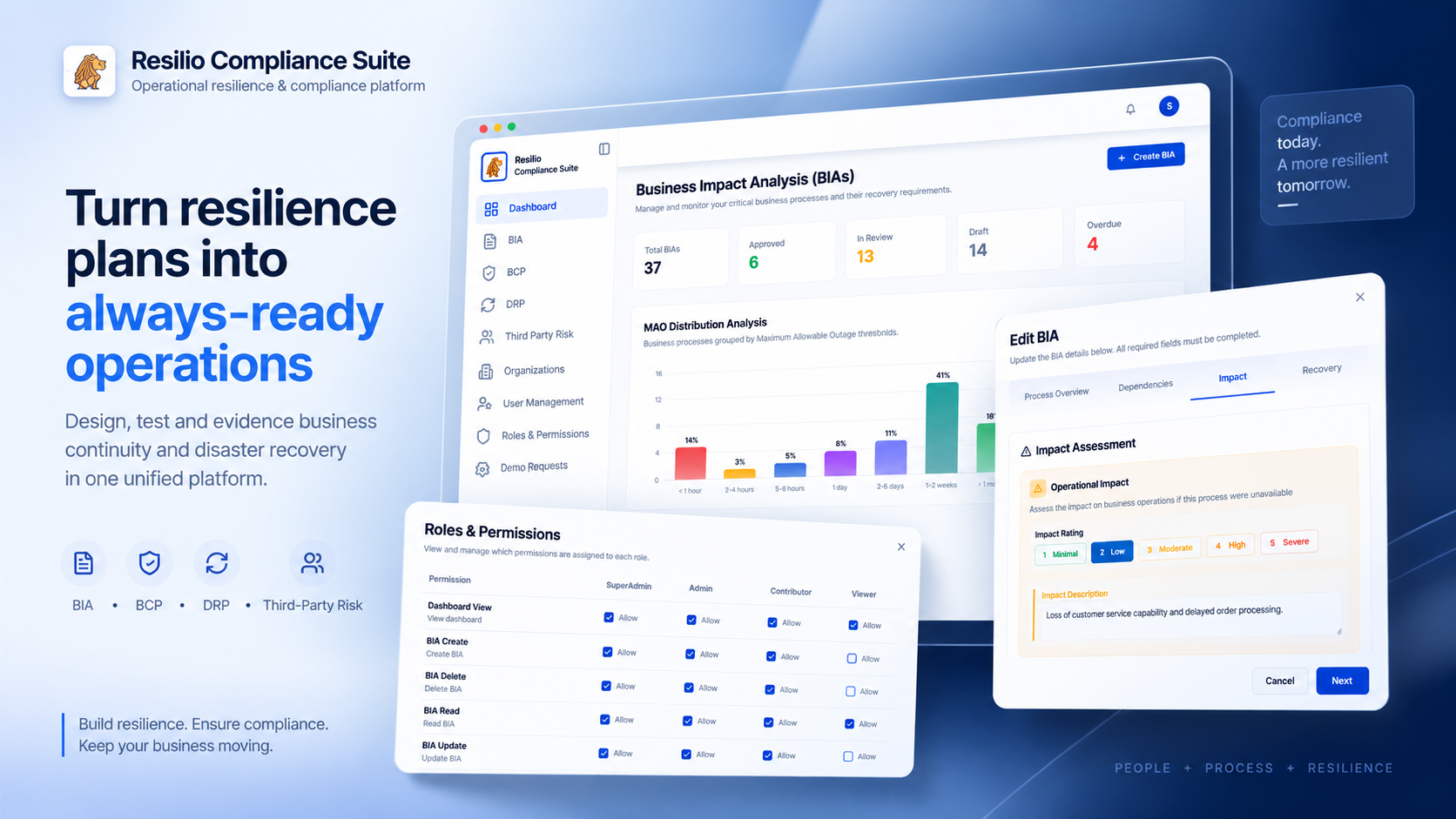
Business Impact Analysis: The BIA module enables organizations to identify critical business processes and evaluate disruption consequences through structured records covering process information, owners, dependencies, supporting systems, criticality, operational impact, recovery requirements, Maximum Allowable Outage, and internal and third party relationships. The workflow is divided into Process Overview, Dependencies, Impact, and Recovery.
Impact Assessment: Users can assess the operational impact of a process becoming unavailable using a standardized rating scale of Minimal, Low, Moderate, High, and Severe, with a detailed impact description to support recovery planning decisions.
BIA Workflow and Status Monitoring: Resilio tracks every BIA through Draft, In Review, Approved, and Overdue statuses, with summary cards so administrators can identify assessments requiring action before they are used for continuity and disaster recovery planning.
Maximum Allowable Outage Analysis: The Maximum Allowable Outage distribution dashboard groups business processes into recovery thresholds such as less than 1 hour, 2 to 4 hours, 5 to 8 hours, 1 day, 2 to 6 days, 1 to 2 weeks, and more than 1 month.
Dependency and System Mapping: Business processes can be connected to the systems, services, teams, vendors, and resources required for normal operations, helping organizations understand supporting systems, shared dependencies, third party risks, and where disaster recovery plans are required.
Automated DRP Initiation: When a system is linked to a BIA and requires recovery planning, the platform can automatically trigger Disaster Recovery Plan creation so critical systems identified during the BIA process are not left without an appropriate recovery plan.
Final Outcome & Impact
Centralized Continuity Data
Replaced Spreadsheets
Critical Process Identification
Impact-Based Recovery
Automated DRP Coverage
Third-Party Inclusion
Clear Responsibilities
Improved Approvals
Operational disruptions can affect revenue, customer trust, regulatory compliance, and the organization's ability to deliver essential services.